The Schools Speak (December 15th) – What Happens When You Ask: “What Do You Actually Need?”
Five months ago, Global Impact Innovators opened the Bo Hub with a promise: 40 entrepreneurs would get real training at the hub, and the team would visit eight schools to train 368 students in digital literacy—right in their own classrooms. On December 15th, three days before graduation, the team did something that matters more than any ceremony: they went back to those schools to listen.
Four schools. Four conversations. One consistent message: Don’t stop.
Two Pillars, Five Months, One Mission
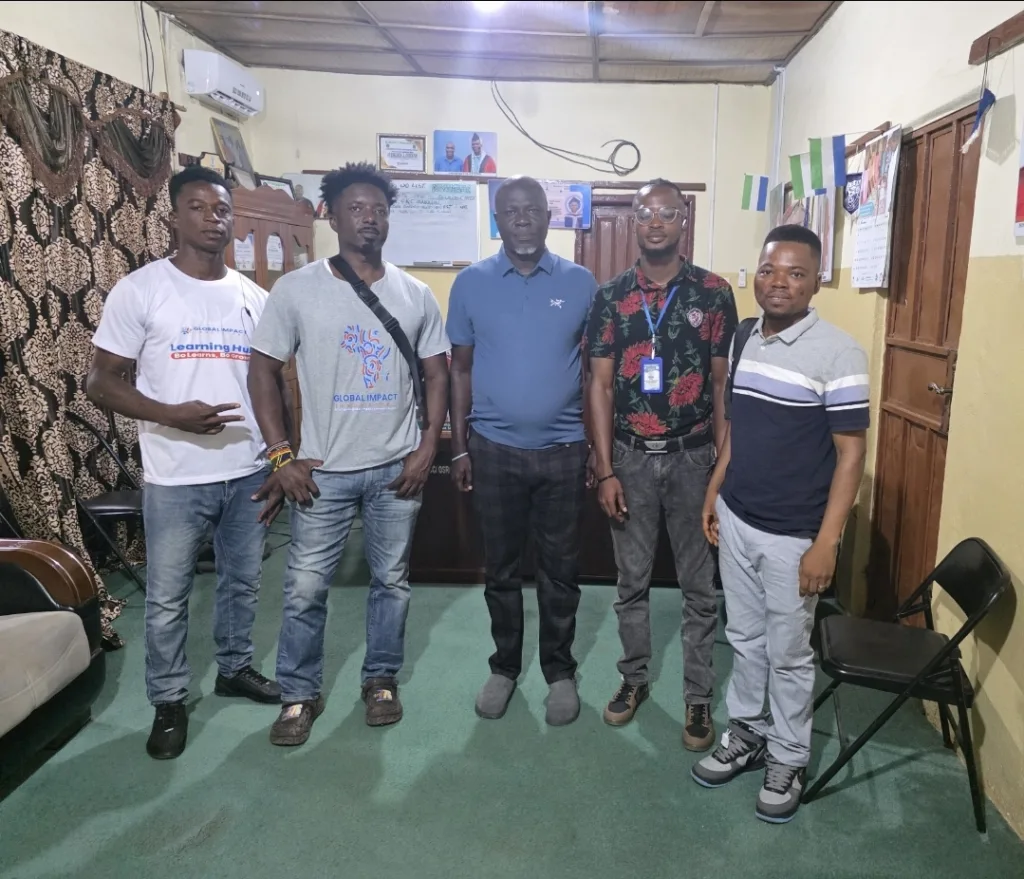
The story begins at 27 Jaka Street in Sheriff Town—the Bo Hub. Since July 18th, 2025, this space has been the home base for something special. Forty entrepreneurs show up here to learn business fundamentals, financial literacy, market analysis, pitch development. Not theory. Real skills for real businesses they’re already building with micro-loans they’ve received.
But the hub is just the beginning. The second pillar takes the team out into Bo’s communities—visiting eight schools once a week to train 368 students and 8 teachers in digital literacy. How to move a mouse. How to create an email. How to research. How to present ideas using PowerPoint and Office tools. Basic skills that, for these students, are revolutionary.
The team doesn’t ask students to come to them. They go to the students—meeting them in their own schools, in their own communities, where they already are. It’s been intense. It’s been ambitious. And as the team visited the first four schools on the 15th, they discovered something crucial: it worked.
Four Schools, Four Powerful Conversations
The team’s route on December 15th told a story about Bo’s diversity. From UMC Primary School in Messima to Kakua Government Junior Secondary School on Baiima Road. From Aladura Junior Secondary School on Musa Street in Kennedy section—a school that’s been serving its community since September 2010—to Bo Center For
Technical Studies at 4 Seibaru Street off the Bol Taiama highway in Mulema town.
Four different locations. Four different communities. Four different school cultures and contexts.
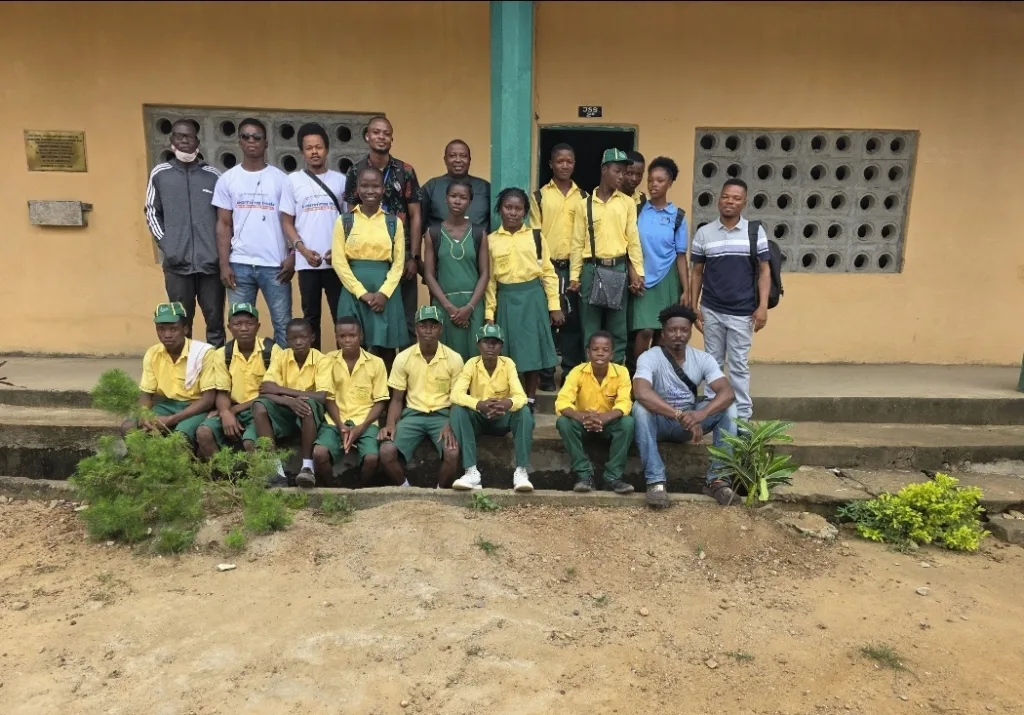
These weren’t courtesy visits. The team was there to have real conversations with the principals, the administrators, the people who see these students every day—the people who’ve watched the transformation happen week by week for five months.
The Schools Have Something to Say
These weren’t polished speeches prepared for visitors. These were real conversations with school leaders who’d watched 46 of their students and 1 of their teachers transform over five months of weekly visits.
And the truth from all four schools was unanimous: This program changed something.
They praised it. They thanked the team for coming to their schools, for meeting their students where they are. And then they did something more important than gratitude: they begged for more. More students. More training. More visits.
“Can we include more pupils next year?” Not just from these four schools. From all eight. The pilot worked so well that the question isn’t “should we continue?” It’s “how fast can we expand?”
Forty-six students per school was deliberate—a pilot designed to test what works, to learn what’s needed, to build something sustainable before scaling. And it worked. Now the schools want the doors opened wider.
The Request That Changes Everything
But here’s where it got interesting. Every school leader brought up the same gap: our teachers need this training too.
The beauty of having one teacher from each school go through the training alongside the students was clear. But what about the other teachers? The ones watching from the sidelines? The ones who see their colleague learning and their students advancing and realize: I need this too.
Not one of most teachers in Bo has formal ICT training. Not one.
So the school leaders asked: could there be a comprehensive teacher training program? Could more of the adults who educate these children get the same foundation? Because without that, what happens when the GII team isn’t visiting anymore? Who continues the work?
That’s the question of sustainability wrapped in a simple request. And it’s brilliant.
Taking It to the Government
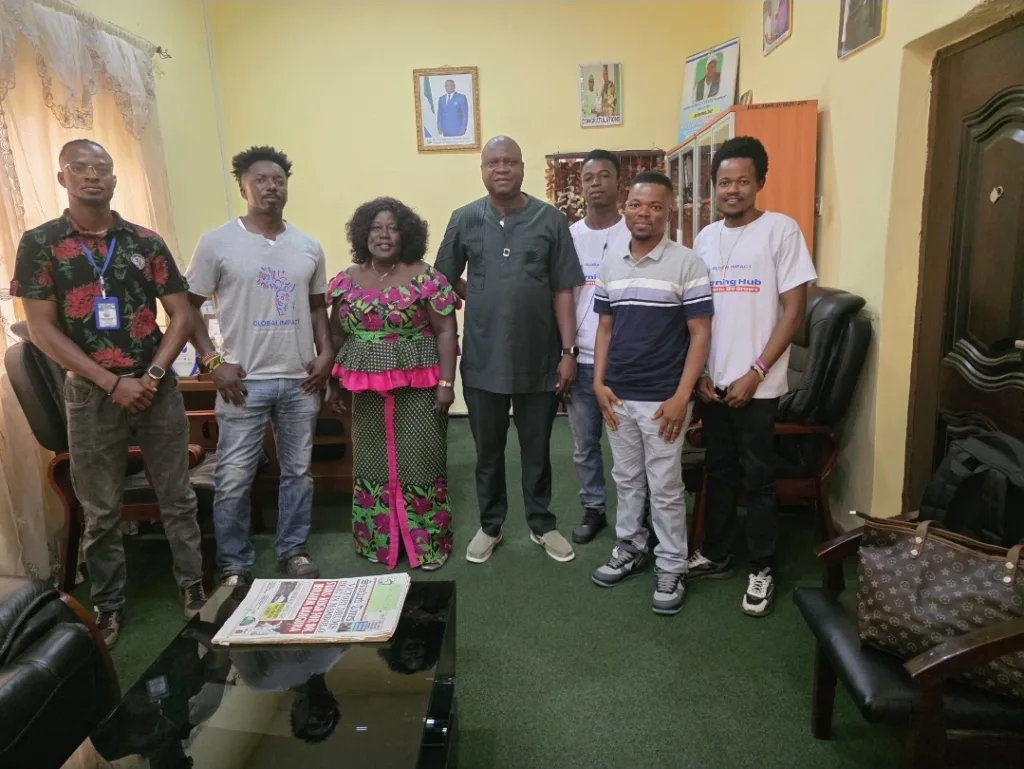
After the school visits, the team didn’t stop. They went to the people who make decisions about education policy in Bo.
Five critical stops:
- Ministry of Education Bo — the primary authority on educational programming
- Ministry of Social Welfare, Gender and Child Affairs — focused on vulnerable populations and youth development
- National Youth Commission, Bo — directly responsible for youth empowerment initiatives
- Bo District Council — governing the broader district
- Bo City Council — governing the urban center
At each office, the team shared what they’d learned. Not as outsiders asking for permission, but as partners reporting results and seeking collaboration.
And at each office, they heard the same thing the schools had said: This matters. Keep going.
The Reality Check: 17 Out of 980
It was during these government meetings that the team learned the numbers that put everything in perspective.
Bo District has approximately 980 schools. Primary schools, secondary schools, high schools. Public and private. Schools that serve specific neighborhoods, specific communities, specific needs. Nine hundred and eighty schools full of young people who need to be prepared for a world that runs on digital literacy.
And how many of those 980 schools have ICT programs?
Seventeen
Let that sink in. In a district of nearly a thousand schools, only seventeen claim to offer ICT training. And here’s the part that makes you wince: most of those seventeen aren’t practical. Teachers draw computers on blackboards. Students memorize parts of a machine they’ve never touched. It’s called an “ICT program” on paper, but it’s theater, not training.
For the other 963 schools? Digital literacy isn’t even pretend. It’s absent.
What This Model Is Proving
The four schools visited on December 15th represent the diversity of Bo’s educational landscape. UMC Primary School serving young learners in Messima. Kakua Government Junior Secondary School as a public institution on Baiima Road. Aladura Junior Secondary School, founded in 2010, serving Kennedy section. Bo Center For Technical Studies focusing on technical skills in Mulema town.
None of these schools had to have computer labs. They didn’t need infrastructure advantages or unique resources. The GII team brought the training to them—meeting students in their own classrooms, working with what each school already had.
And now, after five months, those schools are proof: this works. Digital literacy doesn’t require perfect conditions or expensive infrastructure. It requires a team willing to show up, week after week, bringing the training directly to communities.
Jeremiah and the Team Who Made It Real
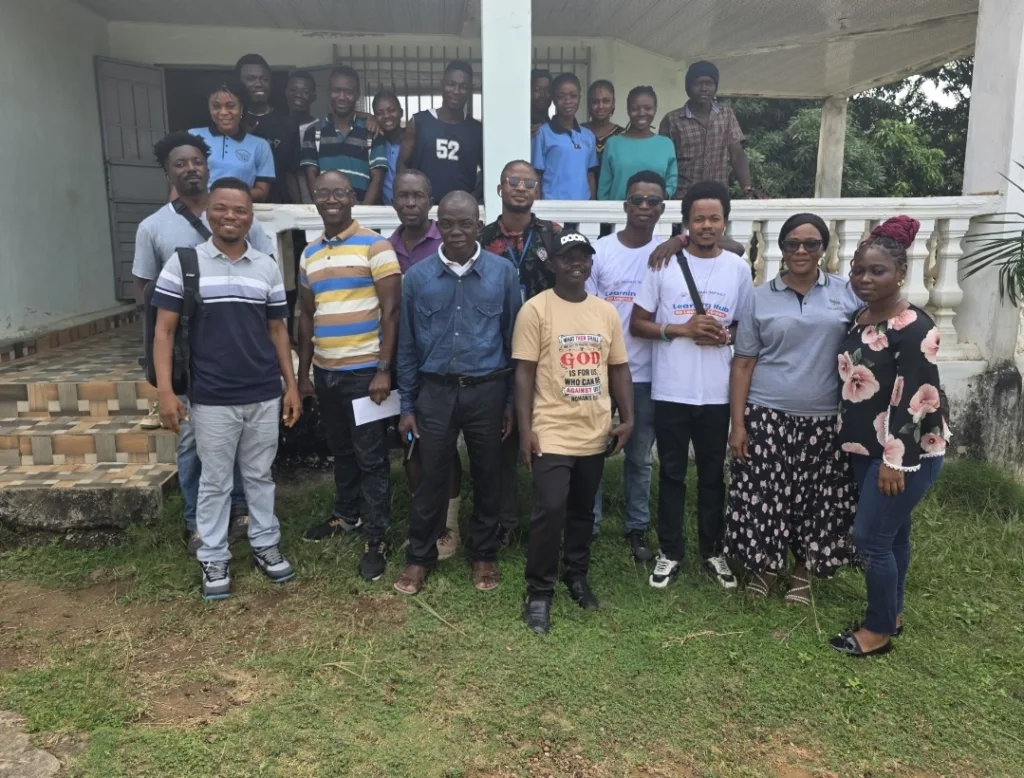
None of this happens without Jeremiah Muhea Squire and his team on the ground in Bo. Not the training at the hub. Not the weekly visits to eight different schools across Bo. Not the trust built with administrators and students. Not the meetings with five different government offices in one afternoon. Not the daily grind of showing up, troubleshooting, adapting, pushing forward.
The team didn’t just execute a program. They owned it. They made it theirs. They turned a pilot into something Bo can be proud of.
When school leaders at UMC, Kakua, Aladura, and Bo Center For Technical Studies praise the program, they’re praising Jeremiah and his team for showing up every week. When government officials at the Ministry of Education and the Bo City Council ask how to expand it, they’re recognizing what this team built. When students show up eager to learn, it’s because the team comes to them—meeting them where they are.
This isn’t an external program being imposed on Bo. This is Bo building something for itself, with a team that believes in it.
Three Days to Graduation
On December 18th, forty entrepreneurs will graduate. They’ll walk across a stage at the hub that’s been their home for five months, receive their certificates, and showcase the businesses they’ve already launched. Four MVP businesses that went from idea to reality because these entrepreneurs received micro-loans and got to work. It will be a celebration. A milestone. A moment families will remember.
But December 15th mattered just as much. Because that’s the day the team learned that they didn’t just run a successful pilot. They created demand. They proved a model. They heard from the community: We want more of this. We need more of this. Don’t leave us behind.
Four schools visited. Five government offices engaged. Four schools asking for expansion. And four more school visits coming the next day.
The graduation is the ceremony. But these conversations? This is the work.
Read more about how we support youth and women in Africa through our entrepreneurship training programs.